


BLASTER TRUCKS
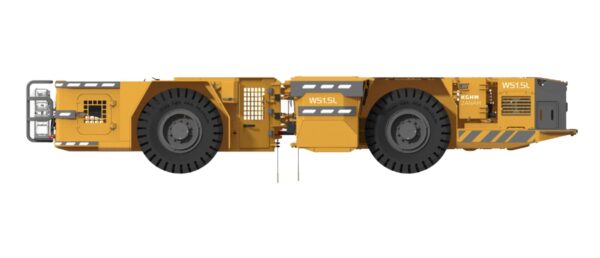
A blaster truck is a self-propelled mining machine on a wheeled chassis, designed to transport unprimed explosives and mechanically load emulsion explosives into blastholes. The current KGHM ZANAM portfolio features one model of a blaster truck: the low-profile WS1.5L from the new machine series.
What is a blaster truck and what is it used for?
A blaster truck performs three tasks in a single duty cycle: it transports unprimed emulsion and cartridged explosives to the production face, manufactures the explosive on-site, and pumps it into the blastholes using a charging unit. Charging is carried out mechanically from the machine’s working platform.
In the production cycle of an underground mine, the machine operates between two other equipment groups:
-
a drilling-bolting rig drills blastholes in the solid rock of the production face;
-
the blaster truck transports the explosive and loads the prepared blastholes,
-
a loader and a load haul dump loader collect the mined material after blasting.
The efficiency of this link determines the rhythm of the entire cycle: the faster the blastholes are prepared, the less time the crew spends at a production face with an elevated rockburst hazard.
KGHM ZANAM blaster truck: the WS1.5L model
This is a low-profile design just 1,500 mm high, intended for workings with restricted height. The machine retains the full emulsion tank capacity of 750 dm³ and an engine power of 115 kW, while the battery-powered pumping unit allows blastholes to be charged without the combustion engine running. It is an ideal solution for mines extracting thin seams, where standard machines would not fit within the working’s dimensions.
The protective structures of the cab and the personnel compartment protect the operator and passengers against the impact of a rock fragment with an energy of up to 60 kJ.
Discover the WS1.5L blaster truck
Development of the series
The WS1.5L is the first machine in the new series of KGHM ZANAM blaster trucks. Next year, further designs from this family are scheduled for launch: the WS1.7 and WS1.7A prototypes, which are the successors to the WS-173 and WS-173/S models, respectively.
Technical specifications: WS1.5L
|
Parameter |
WS1.5L |
|
Length |
8,900 mm |
|
Width |
3,150 mm |
|
Height |
1,500 mm |
|
Total weight |
20,000 kg |
|
Emulsion tank capacity |
750 dm³ |
|
Engine power |
115 kW |
|
Travel speed – 1st gear |
4.0 km/h |
|
Travel speed – 2nd gear |
9.0 km/h |
|
Travel speed – 3rd gear |
20.0 km/h |
Combustion and battery drives: two independent power sources
The KGHM ZANAM blaster truck powers its working system using two independent sources: hydraulic pumps driven by a combustion engine, and a battery drive. This solution eliminates a limitation known from previous generations of machines, where the only alternative to the combustion engine was a 500 V electrical cable connected to the mine’s grid.
Unreeling a cable at the production face is time-consuming and cumbersome. As a result, operators often opted to work using the combustion engine, resulting in exhaust emissions and a deteriorated microclimate within the working. The battery drive powering the pumping module enables blastholes to be charged without the engine running, which translates to:
-
reduced exhaust emissions in the enclosed space of the face;
-
lower noise levels in the working area;
-
shorter machine preparation time after entering the face.
Operator and blaster safety
The protective structures of the operator’s station and the personnel compartment protect the crew against a dynamic load with an energy of up to 60 kJ, in accordance with the requirements of the PN-G-59001:1992 standard for self-propelled mining machines. The operator’s cab is located at the front of the vehicle, while the working platform houses a personnel compartment for blasters.
The second pillar of safety is time. The mechanical charging of blastholes reduces the time the crew spends in a production face with a high rockburst hazard; during blasting operations, this parameter is just as vital as the strength of the protective structure itself.
Application in underground mines
KGHM ZANAM blaster trucks are designed for the conditions prevailing in underground metal ore mines: high temperatures, high humidity, and uneven working floors. The machine can negotiate:
-
longitudinal gradients in the direction of travel of up to 15 degrees;
-
transverse gradients perpendicular to the direction of travel of up to 8 degrees.
The vehicle’s weight distribution ensures stability both when driving straight and when turning, whether towards the tractor or the platform. The articulated structure allows it to manoeuvre in narrow roadways and at perpendicularly arranged working intersections, without the need to turn around.
Service, overhauls and spare parts
KGHM ZANAM provides service, overhauls, and maintenance for the mining machines it manufactures. The service encompasses periodic inspections, repairs of the charging system components, and the delivery of original spare parts.
Explore the scope of technical services
Frequently asked questions (FAQ)
What blaster trucks does KGHM ZANAM currently produce?
The current range includes one model: the low-profile WS1.5L from the new series. Prototypes of the WS1.7 and WS1.7A models, the successors to the WS-173 and WS-173/S, are scheduled for launch next year.
How much explosive material can the blaster truck transport?
The explosive component tank has a capacity of 750 dm³. This allows for the manufacture of approx. 1,000 kg of bulk emulsion explosive. Additionally, there is a box for cartridged explosives with a maximum capacity of 100 kg. Blasting accessories, such as detonators and detonating cord, can be transported in separate boxes.
How does a blaster truck differ from a drilling and bolting rig?
A drilling-bolting rig drills blastholes and installs rock bolts. A blaster truck loads the prepared blastholes with explosive material. These are two successive operations in the same cycle, carried out by separate machines.
What type of drive does the KGHM ZANAM blaster truck feature?
The machine has two independent power sources for the working system: a diesel drive with hydraulic pumps and a battery drive operating the pumping unit.
Can the blaster truck operate in low-profile workings?
Yes. The WS1.5L model has a height of 1,500 mm and was designed specifically for low-profile workings.
How is the operator protected against rockfalls?
The protective structures of the cab and the personnel compartment withstand a dynamic load with an energy of up to 60 kJ in accordance with the PN-G-59001:1992 standard.
Do you need a blaster truck matched to the dimensions of your workings? Send us an enquiry – we will select the configuration and prepare the technical specification.